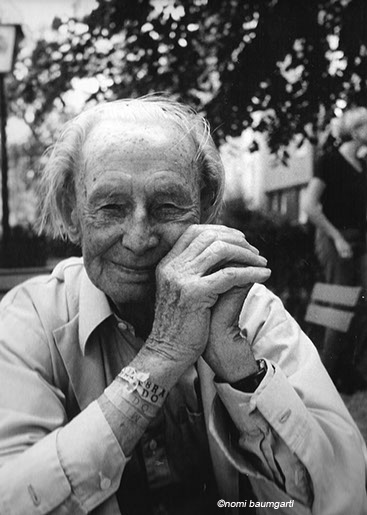
Hilmar Pabel was born on September 17, 1910 in the Rawitsch district of the former Prussian province of Posen in Poland. He grew up in Berlin from the age of two.
The then fourteen-year-old's interest in photography was awakened when he discovered a camera from 1910 in his father's cupboard. He took his first photos himself in the sunlight at his bedroom window. As he had difficulty focusing the camera so that the people in his pictures could not even recognize themselves, he was initially unsuccessful.
He then trained at the Agfa School of Photography in Berlin in 1929. From 1930 to 1935, he studied German, philosophy and journalism at the Friedrich Wilhelm University.
Hilmar Pabel made his first foreign reportage in 1934, when he photographed on a whaler to the Faroe Islands between Scotland and Iceland. From 1935, Pabel tried his hand as a freelance photographer. He received his first notable payment for his photos of the gorilla „Bobby“ at Berlin Zoo. He photographed the gorilla with an extremely lively human expression in his eyes. These pictures, regarded as highly original portraits, became an international success. He was commissioned by the Wehrmacht to take photographs from 1939 until the end of the war as a photojournalist. His photos appeared in propaganda magazines such as „Signal“ and „Erika - die frohe Zeitung für Front und Heimat“.
His experiences during the Second World War contributed significantly to his later work as a photojournalist. After the war, he made it his mission to fight violence, hardship and hunger with the means of photography. For example, the youth magazine „Pinguin“, published by Erich Kästner, published the campaign „Lost children search for their parents“, which he supported. From 1948, he then worked
For 14 years, he worked as a permanent photojournalist for the magazine „Quick“. In 1956, he was the first German photojournalist to travel to China on assignment for „Quick“. His book „Im Antlitz des Ostens“ (In the Face of the East) was published about this trip. At the beginning of the sixties, Pabel moved to „Stern“. He established himself as a specialist in politics in Bonn during the founding years of the Federal Republic of Germany. In the then capital, he photographed politicians, especially the Federal Chancellor, at public events and on private vacations. Hilmar Pabel severed his contractual ties with Stern in 1970 and from then on worked as a freelance journalist again. In 1985, for example, he traveled to China again for „Expedition Seidenstraße“ and a year later to Canada for „Auf den Spuren der Goldgräber“. Together with his wife Romy, he published the pictures and travel reports in illustrated books of the same name. Photos from his work have also appeared worldwide in magazines such as TIME Magazine, LIFE and ZEITmagazin. For his reportages, Pabel usually used two Leica cameras, equipped with a 28mm wide-angle and 60mm macro lens.
During his photographic career, Pabel received various awards and prizes, including four gold medals from WORLD PRESS PHOTO, the German Culture Prize for Photography, two Federal Crosses of Merit and the Golden Aperture. Hilmar Pabel died at the age of 90 in the presence of his family in Alpen near Wesel.
With his photos, he wanted to draw attention to human suffering in the world. Commercialism was of secondary importance to him; individual fates were always of the greatest interest to Pabel. He sought personal contact with his protagonists and often met them again years later. For him, this kind of confrontation was „living journalism“. The personal connection was so important to him that he would have preferred to do without a photo rather than offend the dignity of a person, regardless of the opinion and attitude of his counterpart.
Through his extraordinary photo
style, Pabel shaped contemporary photojournalism. His proximity to people brought him unusual perspectives. His photos are convincing due to their closeness to life and expressiveness; they are „simple“ pictures that are given their documentary character through their simplicity. Pabel was one of the first photojournalists to compile entire series of pictures into extensive reportages.